Start with the numbers
The model, at a glance
Top available variants, with prices in Nepalese rupees. Expand details to choose another variant.
| Vehicle | Ex-showroom price | Fuel | Selected variant |
|---|---|---|---|
| 01Tata Tiago EV | Rs 29.99 lakh | Electric | LR XZ+ Tech Lux |
Ex-showroom prices exclude registration, road tax and insurance. Specifications can vary by trim. See individual source-check dates ↓
Where This Hatchback Fits Into Nepal's Slow-Growing EV Shelf
Electric cars still sit at the cautious end of the Nepali market, and price and range anxiety are the two main reasons. The Tata Tiago EV, brought in by Sipradi Trading Pvt. Ltd. since 2022, was built to answer that hesitation. At Rs 27.49 lakh for the LR XT and Rs 29.99 lakh for the LR XZ+ Tech Lux, it sits at the entry point of Nepal's EV pricing ladder, well below the premium electric SUVs that dominate showroom floor space and marketing budgets. It does not try to be a statement car. It tries to be a sensible one. For a large slice of Nepali buyers looking at their first electric vehicle, that is the pitch that matters.
A Simple, Slightly Bland Face That Grows On You In Traffic
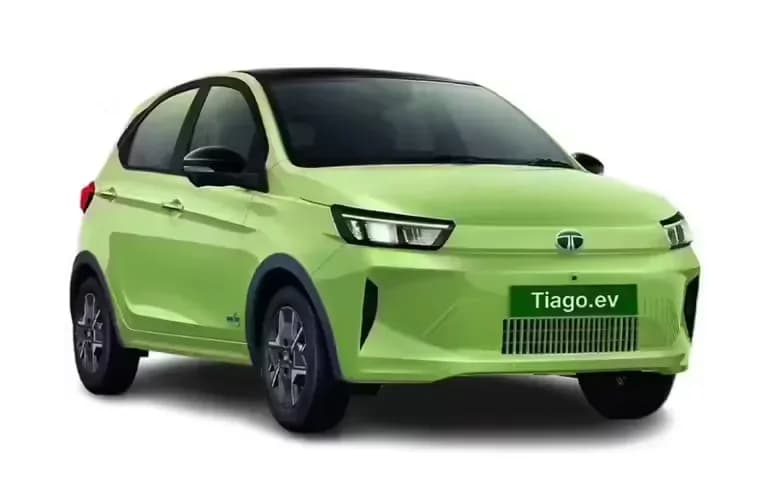
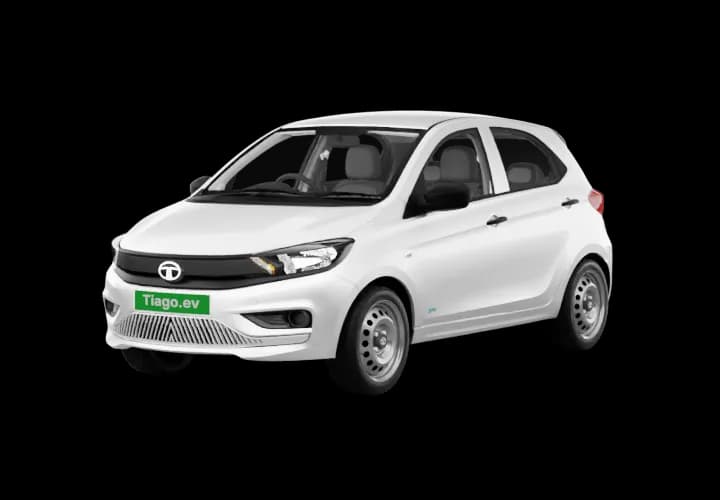
The Tiago EV's front end carries a redesigned bonnet, reshaped fenders, and LED headlights, with the grille area blanked off in the way electric cars tend to signal what they are without a badge. The bumper is finished in body colour throughout, and that gives the car a clean, unfussy look. Up close, it also flattens the design into something a little monotone. There is no contrasting trim or texture break to lift it, and next to the sportier detailing on the combustion Tiago, the EV can look plain.
The black plastic fender flares are meant to add visual width and mostly succeed. They also make the standard 14-inch wheels look undersized inside those wheel arches. It is a small thing, but it stands out the moment you walk around the car at a showroom rather than glance at a photo. Around the back, there is a redesigned bumper, an updated tailgate, and new LED taillights joined by a red strip that does not light up. Build quality itself feels solid for the segment, with no obvious rattles or panel gaps that would worry a buyer doing a walk-around inspection.
The Colour Palette Leans Soft And Approachable
Showroom stock has leaned toward a light beige, almost pastel-pink shade that suits the car's friendly, unthreatening character rather well. It photographs softly and does not show road dust as harshly as darker paints. A light blue option is also available and gives the car a slightly cooler, more youthful look.
Buyers cross-shopping with the Tata Punch EV will notice that car offers punchier dual-tone options like yellow-and-grey. That only reinforces how much more conservative the Tiago EV's palette feels by comparison. It is not a dealbreaker. It is worth knowing before you commit to a colour on the order form.
What You Actually Get For Your Money Inside The Cabin
The bigger news with this generation of Tiago EV is the equipment jump. A 10.2-inch touchscreen infotainment system anchors the dashboard, and it is sharp and quick to respond, with support for wireless smartphone connectivity that removes one of the most common daily annoyances in cheaper cars. Both variants get a digital instrument cluster, described internally as advanced on both the LR XT and the range-topping LR XZ+ Tech Lux, though it sits free-standing without a protective cowl. That keeps the dashboard looking modern, but leaves the display a touch more exposed to glare.
Physical dials remain for climate control, which counts as a genuine plus rather than a compromise. Touch-sensitive HVAC panels look premium in a showroom but are consistently harder to use one-handed while driving, and Tata has resisted that trend here. Automatic climate control is standard on the Tech Lux and included on the LR XT as well, according to our data. The gear selector is a rotary dial rather than a conventional lever, and it operates without the shifting delay between Drive and Reverse that dogged earlier versions of this system.
What is not officially confirmed is the exact touchscreen specification on the entry LR XT variant, nor whether the driver's seat gets height adjustment on either trim. Buyers who need that adjustability should confirm it in person before signing.
An Electric Motor That's Happiest Below 80 Km/h
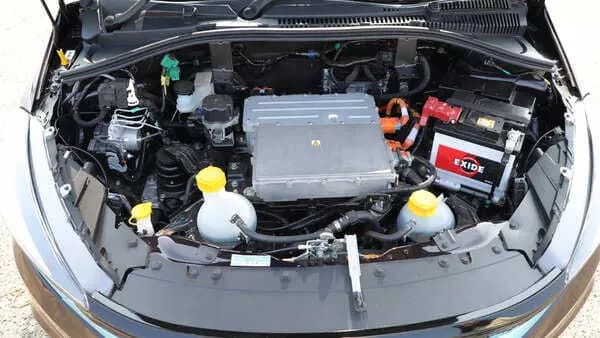
Under the floor sits a 48 kW Permanent Magnet Synchronous Motor producing 65.3 PS and 114 Nm of torque, driving the front wheels through a single-speed automatic transmission. In practice that translates to instant torque delivery from a standstill, which makes the Tiago EV feel notably zippy pulling away from traffic lights and threading through Kathmandu's stop-start congestion. That is exactly the environment this car is built for.
The steering is light at low speed, which pairs nicely with that eager throttle response for tight U-turns and parking manoeuvres.
Push it onto open highway stretches and the character changes. Acceleration tapers off noticeably above 80 km/h, which is worth knowing if long-distance touring is part of your plan rather than an occasional necessity. Refinement, as with any EV, is excellent. There is no engine note to mask road and wind noise, and the cabin stays hushed even as speed builds. This is a car engineered for the daily commute rather than the open road, and it does not pretend otherwise.
Ride Quality That Punches Above The Price Tag
This is arguably where the Tiago EV impresses most. Ride quality absorbs broken tarmac and speed bumps with a composure that feels a class above its price point, and the low centre of gravity created by the floor-mounted battery pack gives it a planted, confident feel through corners that smaller hatchbacks often lack. At higher speeds on the highway, the car tracks straight and does not get unsettled by crosswinds, which is a reassuring trait on Nepal's exposed stretches of highway between towns.
The steering builds weight progressively as speed rises, moving from light and easy in city traffic to reasonably confident on the open road. It will not excite a keen driver, but that is not really the brief here. The priority is a car that is unintimidating for a first-time or occasional driver, and on that measure it delivers convincingly.
Comfortable Up Front, Fair In The Back
Front seat comfort has been improved with better thigh support and side bolstering, and the driving position is generally good, though the steering wheel adjusts only for tilt and not for reach. Taller drivers may need a little longer to find their ideal position. Fabric upholstery is used across the five-seat layout in both variants, with the LR XZ+ Tech Lux getting noticeably better interior trim and cabin materials than the LR XT.
Rear seat space is decent for the segment, and a passenger around 5'8" should find headroom and legroom acceptable rather than cramped. That is not a given in cars this compact. Rear AC vents make a real difference to back-seat comfort during Kathmandu's hotter months, when cars without them tend to feel stifling for rear occupants on longer drives.
Safety Kit That's Solid But Not Fully Disclosed
Reverse parking sensors are standard across the EV range, and regenerative braking is fitted to help manage speed and extend range without constant pedal braking. What we cannot confirm with certainty for the Nepal-spec cars is the exact airbag count or the full suite of electronic stability aids. This has not been officially disclosed for our market as of writing, and buyers who prioritise this should ask the dealership directly for written confirmation on the exact spec sold here, rather than assuming global-market figures apply.
Living With One: Boot Space, Range, And Charging
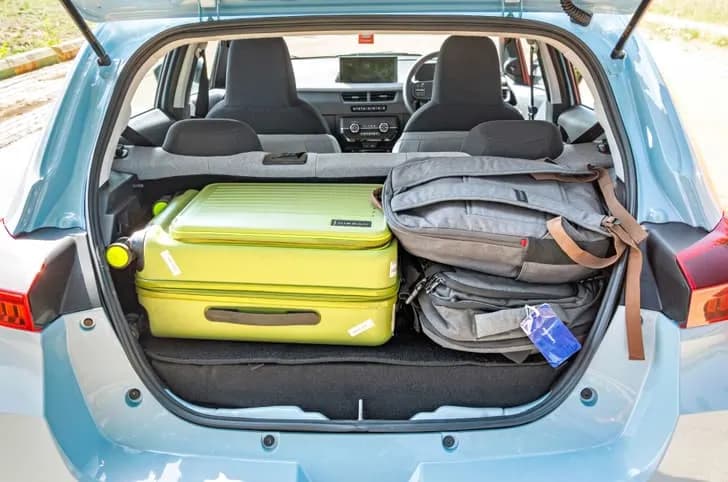
Practicality is a mixed bag but skews positive. The compact 3781 mm length and light steering make this an easy car to thread through narrow lanes and tight parking spaces, which counts for a lot in Nepali cities. The 24 kWh lithium-ion battery pack, offered in this Long Range configuration across both variants, is officially claimed to deliver 250–291 km on a full charge, though real-world driving has shown figures closer to 205 km. That gap is worth building into your expectations rather than treating the claimed number as gospel.
For most owners doing typical daily commuting rather than long intercity runs, that real-world range should comfortably stretch across several days between charges. Running costs are where the EV proposition earns its keep regardless of the range gap. Electricity costs a fraction of petrol per kilometre, and with Nepal's fuel prices what they are, that gap compounds quickly over a year of ownership.
Picking Between The LR XT And The LR XZ+ Tech Lux
The LR XT, at Rs 27.49 lakh, gets you the core package: the 24 kWh battery, the digital instrument cluster, and automatic climate control, without the richer interior trim of the range-topper. The LR XZ+ Tech Lux, at Rs 29.99 lakh, adds a noticeably more premium cabin finish and upgraded seat and interior materials, for a difference of exactly Rs 2.5 lakh.
Our take is that the LR XT is the more rational buy for someone purely chasing an affordable, no-fuss electric commuter, while the Tech Lux makes sense only if the nicer cabin materials genuinely matter to you day to day. It does not bring extra range or a different motor, just a better-finished interior around the same underlying car.
The Tata Punch EV Is The Rival That Really Matters Here
The most relevant competitor for the Tiago EV is not really another brand. It is Tata's own Tata Punch EV, which sits on a more modern platform with a properly packaged underfloor battery layout rather than the Tiago EV's split battery design. That split arrangement in the Tiago EV preserves cabin space reasonably well but does not allow for the same flat, unified underfloor battery treatment the Punch EV manages, and it shows in how the two cars are positioned.
As the Tiago EV's pricing climbs toward its Tech Lux ceiling, that gap to the Punch EV narrows enough that buyers stretching their budget toward Rs 30 lakh should genuinely cross-shop the two before deciding. The Tiago EV wins on outright affordability at the entry LR XT price point. The Punch EV increasingly looks like the more complete, modern package the closer you get to Rs 30 lakh.
Our Verdict: Who Should Actually Buy This
The Tata Tiago EV succeeds at exactly what it sets out to do. It puts electric motoring within reach of Nepali buyers who have been priced out of every other EV on sale here. It is easy to drive, comfortable enough for daily use, well-equipped for its price, and cheap to run once you have bought it. Its weaknesses are honest ones: acceleration fades on the highway, some spec details for our market remain undisclosed, and the range-topping trim edges close enough to the Punch EV to demand a second look before you commit.
This is a car best suited to city-first buyers, or households wanting a dependable second car for daily errands and commuting rather than long highway hauls. For that buyer, at this price, in this market, it remains one of the more sensible electric purchases available in Nepal today.
Explore full specifications, variants & ownership context
Know the product
Key specifications, features & ownership context
Choose a variant to see its recorded specifications and features. Equipment and prices can change across trims.
Latest catalog and directory records supplement the original analysis. Figures may have changed since publication; individual specification and price-check dates appear below.
Rs 29.99 lakh ex-showroom · source checked 23 Sept 2026
Battery & charging
| Specification / feature | LR XZ+ Tech Lux |
|---|---|
| Battery | 24 kWhResearched · confirm · 5 Sept 2026 |
| Claimed range | 315 km (MIDC)Researched · confirm · 4 Oct 2026 |
Dimensions & weight
| Specification / feature | LR XZ+ Tech Lux |
|---|---|
| Ground clearance | 166 mmResearched · confirm · 29 Sept 2026 |
| Boot space | 240 LVerified specification · 22 Sept 2026 |
Claimed range uses the stated test cycle. Different cycles are not a like-for-like range comparison; actual range depends on roads, load, speed and weather.
Showroom & service support
Distributor: Sipradi Trading Pvt. Ltd.
208 listed brand showrooms · 49 listed brand service locations
Listed cities include Baglung, Banepa, Bhairahawa, Bhaktapur, Bharatpur, Biratnagar and 35 more.
Brand-wide directory coverage. Confirm that your nearest workshop supports this exact model, powertrain and warranty work; ask about parts availability and booking time.
Market buzz & buyer priorities
Compiled discussion, including buyer reactions and ownership reports; this is not a verified owner survey or a reliability score. Research dated 14 Oct 2026.
What people like
- Highly affordable entry point into the electric vehicle market in Nepal
- Excellent for daily city commuting with very low running costs
- Feature-rich cabin including wireless smartphone connectivity and 360-degree camera
More feedback
- Smooth and brisk acceleration in urban traffic conditions
- Strong brand reputation and established service network across Nepal
- Nepali buyers view the Tiago EV as an affordable five-seat electric hatchback with lower running and maintenance costs than a petrol car.
- Its compact size is considered useful for Kathmandu Valley traffic and everyday city driving.
- Some Tata owners and buyers value the brand’s parts availability and established service presence in Nepal.
Concerns to investigate
- Battery performance is poor and does not meet advertised range.
- High price compared to petrol vehicles and other EVs.
- Battery warranty perceived as a scam
More feedback
- Quality concerns regarding Tata vehicles in general.
- Misleading range claims by the manufacturer.
- Battery quality is considered subpar compared to competitors.
What buyers ask for
- Daily commuting range within the valley
Nepal ownership context
- Widely recognized as a practical city car for Kathmandu valley roads
- Tata's extensive service network in Nepal provides peace of mind for maintenance and spare parts
- Ground clearance is generally considered sufficient for urban speed bumps and paved city streets
More feedback
- Resale value is supported by the strong demand for budget-friendly electric hatchbacks
- Nepali buyers mainly position the Tiago EV as a city-focused car; suitability for longer trips depends heavily on route charging and access to home charging.
- Service access, spare-parts availability, battery warranty support and future resale value are major Nepal-specific concerns in buyer discussions.
Use these facts alongside the article’s full analysis. Check the final quotation, warranty terms and exact equipment before booking.
Evidence & next steps
Check the details before you buy
Use this guide to build a shortlist. Ask for a written quotation for your chosen variant, including registration, taxes, insurance, finance charges and any charger installation. Confirm the nearest authorised workshop supports that model.
Price sources and dates
These are the recorded distributor-source checks for the selected overview trims. They are separate from the article update and catalog read dates; they do not mean every trim was rechecked today. Confirm the final price with the distributor.
Overview photos come from the corresponding model records; additional article photos carry their own credits. Running costs depend on usage, energy prices, maintenance, insurance and resale value.