Start with the numbers
Compare at a glance
Available variants, with prices in Nepalese rupees.
| At a glance | Tata Harrier EV | VinFast VF7 |
|---|---|---|
| Ex-showroom price | Price on request | Price on request |
| Fuel | Not recorded | Not recorded |
| Selected variant | Matching variant not confirmed | Matching variant not confirmed |
Ex-showroom prices exclude registration, road tax and insurance. Specifications can vary by trim. See individual source-check dates ↓
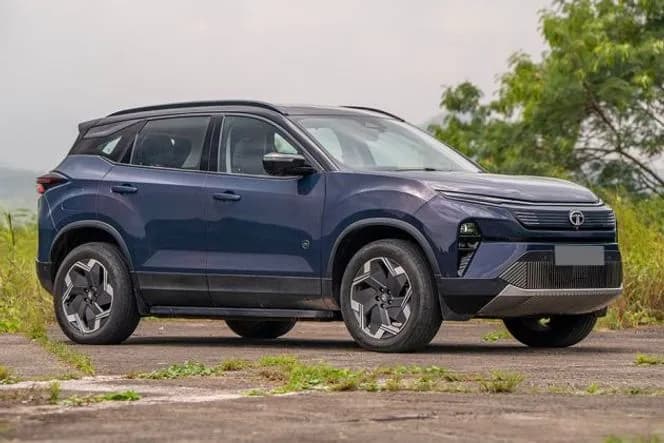
Nepal’s EV market is slowly moving beyond compact crossovers, and the recent comparison from India between the Tata Harrier EV and VinFast VF7 gives a clear hint of the premium electric SUVs that could start to matter here.
Price band and Nepal angle
In India, the Tata Harrier EV is priced around Rs 21.7–29.2 lakh (ex‑showroom), while the VinFast VF7 sits near Rs 23–28.1 lakh (ex‑showroom). Converted with import duties and taxes, these would likely land well above Rs 70 lakh on‑road in Nepal. That puts them into the high‑end EV bracket for urban buyers and corporate fleets, not the mass market.
Tata already sells the Nexon EV in Nepal via authorized distributors, so the Harrier EV is a realistic future candidate if demand for larger, longer‑range electric SUVs grows. VinFast does not yet have an official presence in Nepal, but its regional expansion in Asia means the VF7 could be a medium‑term possibility if the brand decides to enter new right‑hand‑drive markets.
Key technical highlights
- Tata Harrier EV (AWD, top variant)
Battery: 75 kWh Claimed city efficiency: about 5.45 km/kWh Real‑world city range: roughly 409 km Highway efficiency: around 5.24 km/kWh (~393 km range) Focus: strong regenerative braking, better urban efficiency, higher claimed range despite a heavier body.
- VinFast VF7 (AWD, top variant)
Battery: 70.8 kWh Power: roughly 40 hp more than the Harrier EV, similar torque Performance: about 0.7 seconds quicker to 100 km/h; faster in rolling acceleration runs too Highway efficiency: about 5.92 km/kWh, giving ~419 km highway range Focus: stronger outright performance and better highway efficiency.
City vs highway use: lesson for Nepali buyers
For Nepali conditions, where most EVs spend their time in dense urban traffic with frequent braking, the Harrier EV’s stronger regenerative braking and better city efficiency stand out. That kind of tuning directly matches usage in Kathmandu, Pokhara and other cities, where range anxiety is often about crawling traffic rather than long distances.
The VF7’s better highway efficiency and quicker performance point to future EVs that could suit inter‑city routes like Kathmandu–Pokhara or East‑West Highway travel, provided Nepal’s fast‑charging network keeps improving.
Brand trust and warranties
For Nepal, Tata’s existing sales and service network through its ICE models and Nexon EV is a major advantage; buyers already know what to expect in terms of parts and workshop coverage. The Harrier EV reportedly offers a lifetime battery warranty for the first owner, plus a 3‑year/1.25 lakh km vehicle warranty, which would be appealing in a market still learning long‑term EV ownership.
VinFast, while new, answers with a 10‑year / 2 lakh km warranty on both vehicle and battery, setting a benchmark that other brands targeting Nepal may feel pressure to match or at least come close to.
What it signals for Nepal’s EV future
For Nepali buyers, this comparison points to two clear trends:
- Future premium EVs will likely offer 400+ km real‑world range, so they become practical beyond city limits.
- Brands will fight on regen tuning, efficiency in stop‑go traffic, and long warranties, not only on peak power figures.
If and when the Harrier EV officially lands in Nepal, it is likely to pull more urban, comfort‑oriented buyers and fleet operators. An eventual VF7‑class rival — whether from VinFast or another brand — would speak more to those who put performance and highway use first at a similar price band.
For now, this India–Vietnam matchup works as a useful reference point for what Nepali EV shoppers can expect from the next wave of premium electric SUVs.
Explore full specifications, variants & ownership context
Evidence & next steps
Check the details before you buy
Use this guide to build a shortlist. Ask for a written quotation for your chosen variant, including registration, taxes, insurance and finance charges. Confirm the nearest authorised workshop supports that model.
Price sources and dates
These are the recorded distributor-source checks for the selected overview trims. They are separate from the article update and catalog read dates; they do not mean every trim was rechecked today. Confirm the final price with the distributor.
Overview photos come from the corresponding model records; additional article photos carry their own credits. Running costs depend on usage, energy prices, maintenance, insurance and resale value.