Start with the numbers
The model, at a glance
Available variants, with prices in Nepalese rupees.
| Vehicle | Ex-showroom price | Fuel | Selected variant |
|---|---|---|---|
| 01TVS iQube | Rs 3.2 lakh | Electric | Standard |
Ex-showroom prices exclude registration, road tax and insurance. Specifications can vary by trim. See individual source-check dates ↓
Where The iQube Sits In Nepal's Electric Scooter Shelf
Jagdamba Motors brought the TVS iQube into Nepal in 2024 at an ex-showroom price of Rs 3,19,900, sold in a single Standard trim. That puts it squarely in competition with other mainstream electric scooters rather than with the premium end of the EV market. There's no tiered lineup here, no base-and-top split to navigate. One battery size, one spec sheet, one number to budget for.
That simplicity is itself a kind of positioning. TVS is leaning on brand recognition built over decades of petrol scooters in Nepal, and the iQube reads like a deliberate attempt to make EV ownership feel unremarkable rather than experimental. For a buyer who has ridden a TVS Jupiter or Ntorq and wants to go electric without relearning how a scooter behaves, this is the pitch.
A Scooter That Looks Like It Was Designed Not To Scare Anyone
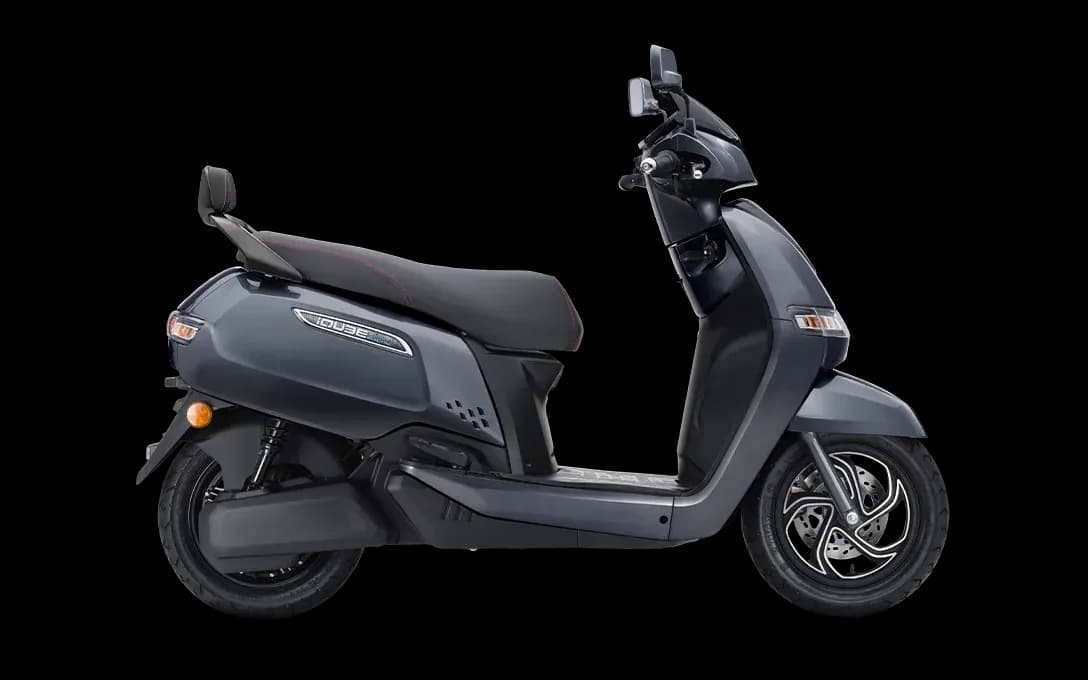
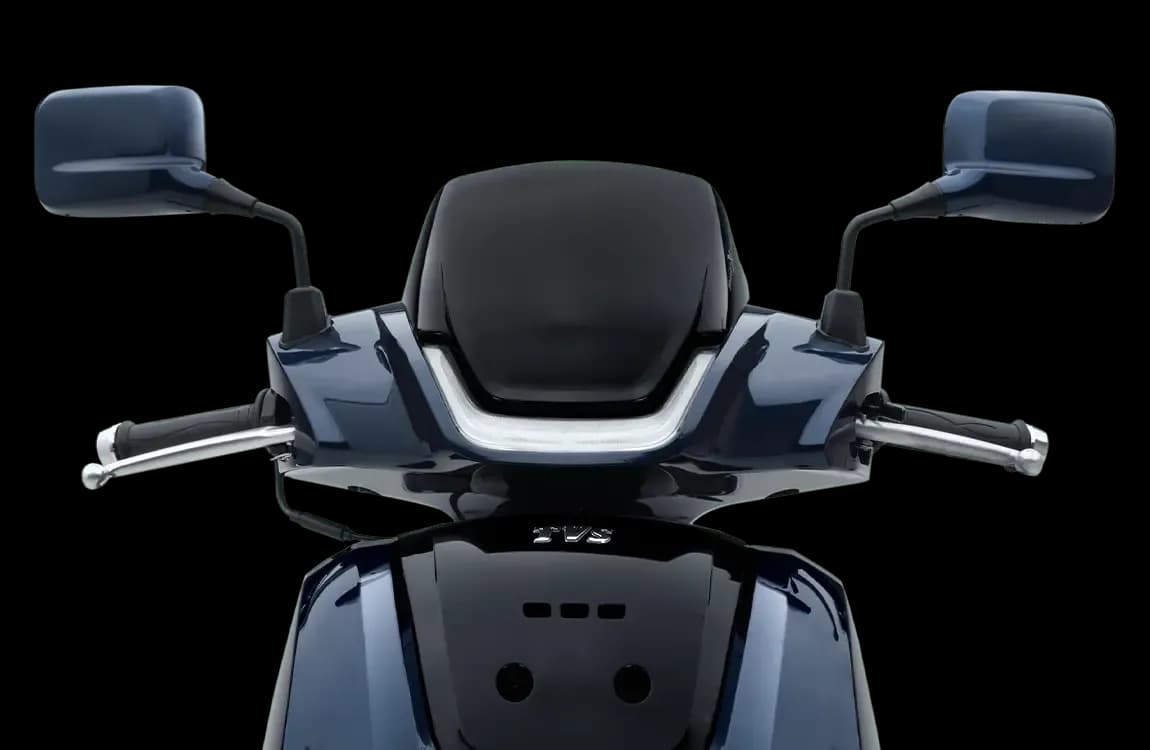
The design brief here seems to have been: don't look like an EV. The iQube wears a flat front fascia with a squared-off LED daytime running light, a piano black visor, and square mirrors that could sit on any TVS petrol model. A wide LED strip runs across the apron between the indicators, and the tail repeats the theme with a slim LED strip and integrated indicators at the back. Nothing about the silhouette announces "electric" the way some rivals do with sharp creases or exposed battery panels.
It sits on an aluminium frame with plastic body panels, which keeps weight down, though TVS Nepal's own brochure figures put kerb weight at around 120 kg once the battery is factored in. That's light for an EV scooter but not featherweight, and it shows in how the bike settles at rest rather than feeling top-heavy.
Build quality is where the compromises start showing. Panel gaps are noticeable in places, and there's a reasonable chance of light rattles developing as the scooter ages and the roads do their work. None of this is alarming, but it isn't tight, either. It's the kind of finish that feels acceptable at this price rather than impressive.
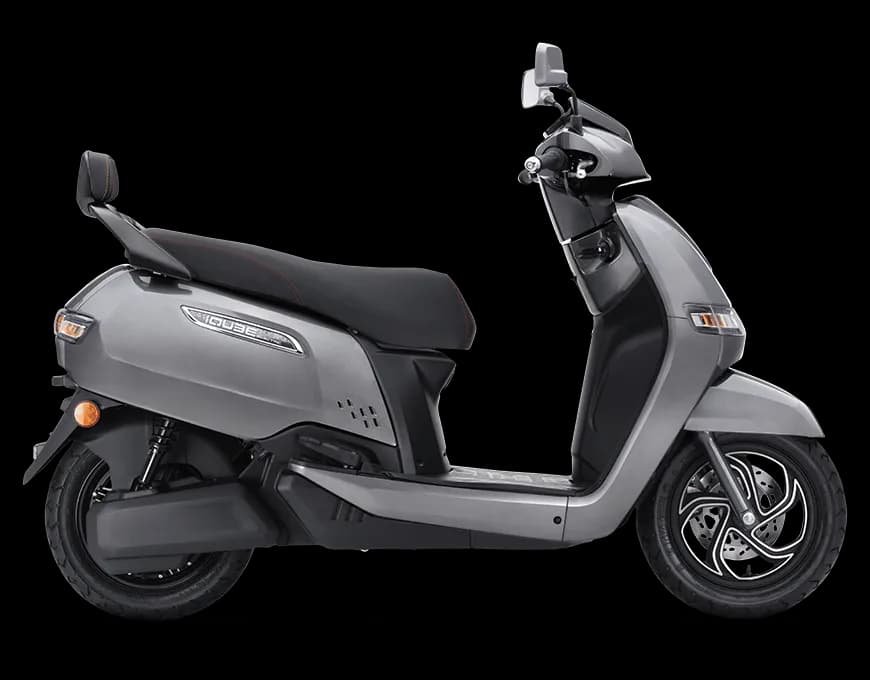
Nepal's test and launch units have mostly been seen in a dark teal, blue-green metallic shade, which suits the understated design better than brighter colours would. TVS Nepal hasn't published a wider palette for the market, so buyers should check current showroom stock before assuming a colour is available.
The 7-Inch Display Does The Basics, Not The Extras
The dashboard is a 7-inch TFT screen, and it's the clearest sign that this is a modern electric vehicle despite the conservative styling. It shows battery level, range, time, odometer, and a distance-to-empty readout, which matters more on an EV than on petrol, since range anxiety is the real adversary here. An Incognito mode lets riders switch off location tracking, a small but genuine privacy nod.
Bluetooth pairing brings calls, SMS alerts, music controls and turn-by-turn navigation prompts to the screen. What it doesn't do is show an actual map. For a segment where rivals increasingly offer full visual navigation, that's a gap TVS has chosen not to close on this trim. The settings menu covers the expected ground: clock, sound, display themes, a custom photo background, brightness.
TVS also offers SmartXConnect subscription plans layered with over 100 features, though the richer connected tools — crash alerts, advanced navigation, messaging — sit behind a yearly subscription once any free trial period ends. Buyers should factor that ongoing cost into total ownership rather than assuming everything on the spec sheet is free for life.
Physically, the switchgear uses the same layout as TVS's petrol scooters, which is good for familiarity but less good in practice: the buttons have a reputation for feeling sticky or oversensitive, sometimes needing more than one press to register. It's a minor niggle, but a persistent one on a vehicle meant to feel refined.
A 3 kWh Motor That Builds Speed Rather Than Snapping It

The iQube's hub motor runs on a 3 kWh battery and is rated for 0-40 km/h in 4.2 seconds, with a top speed of 75 km/h. In practice that translates to power delivery that builds progressively rather than surging the way some direct-drive EV rivals do. There's no violent initial kick when the throttle opens. For riders moving from a petrol scooter, or for less experienced riders generally, that's the safer, more predictable way to deliver electric torque.
The motor itself runs near-silent, with only minor vibration or road noise filtering through at speed. TVS has also built in Q-Park Assist, a silent reverse function that helps with tight parking manoeuvres, and parking assist is listed among the comfort features for the Nepal-spec model.
Regenerative braking plays a bigger role here than on a petrol scooter. Releasing the throttle noticeably slows the scooter down and feeds energy back to the battery, which is part of why real-world range tends to hold up well against the claimed figures. It also changes riding habits a little: once you're used to how much the regen pulls the scooter down, you end up using the mechanical brakes less in steady traffic.
Ride Quality Holds Up Even With 120 kg Of Kerb Weight
The suspension is tuned soft, and that pays off on Kathmandu's patchwork of potholes and speed breakers. It absorbs bumps well even with two people aboard, and the scooter stays composed rather than skittish at speed or on rough tarmac. Given a wheelbase of 1301 mm and ground clearance of 157 mm, it's built with Nepal's road realities in mind rather than smooth, wide boulevards.
Despite that 120 kg kerb weight, the iQube stays manageable in city traffic, tight enough to filter through jams and turn in narrow lanes without feeling like a chore. The 12-inch tubeless tyres at both ends do their share of the work, offering decent grip without feeling nervous on wet tarmac or loose gravel patches common on Valley roads.
Comfortable For Two, With A Seat That Needs A Touch Of Grip
The riding triangle is upright and relaxed, with an easy reach to the handlebar and a flat footboard spacious enough for taller riders to stretch out on. The seat itself is wide, soft and cushioned enough for two adults to share without complaint on a typical commute.
Where it falls short is under braking. Both rider and pillion can feel themselves sliding slightly forward when the brakes bite hard, suggesting the seat foam and contouring could use more grip or a slight lip. It's not dangerous, but it's noticeable, and pillion riders in particular will want a firm grab on the provided grab handle. A side footrest is also included, a small detail that female pillion riders especially will appreciate.
Braking That Does The Job Without Inspiring Confidence
Stopping power comes from a 220 mm front disc paired with TVS's Synchronised Braking Technology, with a rear drum doing the rest of the work. On paper that's a reasonable setup for the price point; in practice, braking feels adequate rather than sharp, and sudden stops take a beat longer to settle than you'd like. The rear drum, in particular, can feel outmatched in stop-and-go traffic where the brakes are being worked constantly.
There's no auto-hold function, which is a miss at traffic lights on Kathmandu's slopes, and the parking brake lever isn't fully reliable either, since the scooter can still roll forward if the throttle is twisted while it's engaged. Riders parking on an incline should still reach for the side stand rather than trust the lever alone.
Where TVS Actually Earns Its Keep: Storage And Charging
The underseat storage is a genuine highlight: 32 litres is enough for a mid-sized helmet plus a smaller one, or a helmet and a reasonable grocery run. Inside, there's a USB charging port for phones and an OBD port for diagnostics, both useful additions that show some thought went into everyday use rather than just the headline numbers.
There's no front glovebox, but a hook and hanger are provided, each rated to carry up to 3 kg, enough for a bag or a light shopping load on the apron. The charging port sits on the left side of the scooter and the pins are on the delicate side, so plugging in needs a reasonably gentle hand rather than force.
Charging itself uses TVS's 950W portable charger, which plugs into any standard 15A socket, meaning no dedicated home wallbox is required. TVS Nepal's own figures put 0-80% charging at around 4 hours 18 minutes, with automatic power cut-off once the battery hits 100%, a sensible safety touch for scooters left charging overnight.
What Owning One Actually Costs Month To Month
The core appeal of any EV scooter is running cost, and the iQube delivers here. Its real-world range tends to track closely with, and sometimes beat, the claimed 100 km figure, largely thanks to how aggressively the regenerative braking recovers energy in typical city riding. For a Kathmandu Valley commute pattern — short daily trips, frequent braking, moderate speeds — that's close to ideal usage conditions for an EV.
TVS backs the iQube with a 5-year or 50,000 km warranty, whichever comes first, applicable to all TVS two-wheelers bought after September 2017 (terms apply, and buyers should check the owner's manual for specifics). That's a longer cover window than many scooters offer and goes some way to offsetting worries about battery longevity, which remains the biggest unknown cost in EV ownership anywhere.
The one running cost to budget for beyond electricity is the SmartXConnect subscription, once any complimentary period lapses. It's not large money, but it is recurring, and buyers comparing total cost of ownership against a petrol scooter should factor it in alongside electricity savings.
The Only Trim There Is: Standard At Rs 3.2 Lakh
Unlike some EV scooters sold with multiple battery sizes, the iQube in Nepal comes in exactly one trim: Standard, priced at Rs 3,19,900 ex-showroom, with a 3 kWh battery and the Synchronised Braking Technology setup described above. There's no decision to make between variants here, which simplifies the buying process but also means there's no cheaper entry point or higher-range option for buyers who want more range than the standard pack gives.
Given that this is the only configuration on sale, it's also the one to recommend by default: whatever strengths or shortcomings the iQube has, they apply uniformly across every unit Jagdamba Motors sells.
The Ather Energy Rizta Argues For More Polish, Not More Price

Within the same broad electric scooter segment in Nepal sits the Ather Energy Rizta, built around a similar family-commuter brief rather than a performance one. Where the two diverge is in finish and software depth: Ather's ecosystem has built a reputation for sharper software, more configurable ride modes and tighter panel fit, areas where the iQube is comparatively plain. Price comparisons between the two aren't confirmed in Nepal yet, so this remains a comparison of character rather than value for now, but buyers cross-shopping family-use EV scooters should look at both before deciding.
The Ather Energy 450 Series Chases Performance The iQube Doesn't
For riders who want more urgency from an electric scooter, the Ather Energy 450 Series sits at a different end of the brief, built around faster acceleration and a more aggressive motor map than the iQube's smooth, linear delivery. It's a reasonable cross-shop for anyone tempted by the iQube's low running costs but wanting a scooter that feels quicker off the line. As with the Rizta, Nepal pricing between the two isn't confirmed, so the comparison here is about intent rather than rupees.
The Niu NQi GT Offers A Different Design Language Entirely
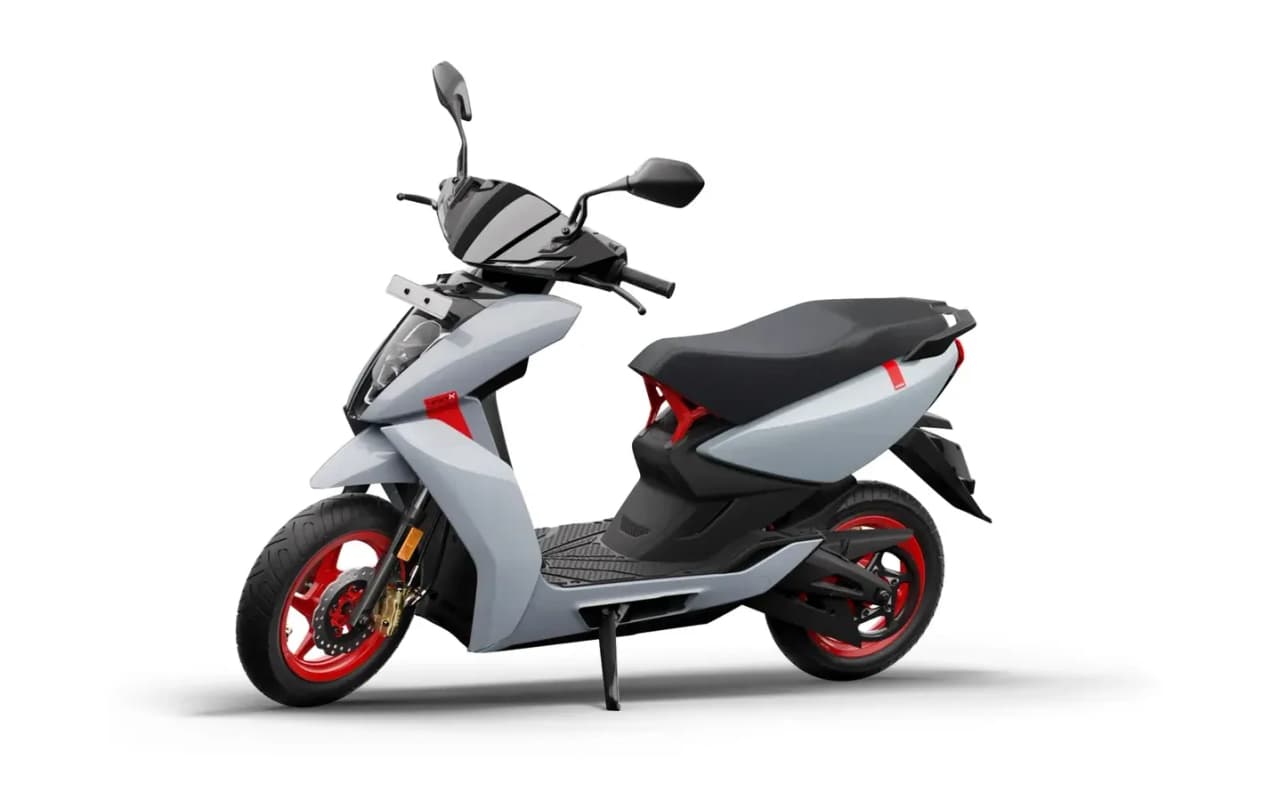
The Niu NQi GT takes a more international, design-forward approach compared to the iQube's deliberately familiar styling. It's worth a showroom look for buyers who find the TVS's conservative lines underwhelming and want something that reads more clearly as an EV rather than a petrol scooter in disguise. Price comparison with the iQube isn't confirmed in Nepal at this stage, so this is a stylistic alternative to weigh rather than a value argument.
Verdict
The TVS iQube is built for buyers who want an electric scooter that behaves like the petrol scooter they already know, without asking them to relearn switchgear, riding position or daily habits. Its real-world range holds up well against its 100 km claim, the underseat storage genuinely earns its keep, and the ride quality copes with Kathmandu's rough edges better than its soft suspension setup might suggest on paper. Jagdamba Motors' spread of showrooms and service centres across cities including Kathmandu, Pokhara, Butwal and Biratnagar also means ownership support isn't confined to the capital.
Set against that is a scooter that doesn't try hard to impress: switchgear feels ordinary, the rear drum brake struggles in heavy traffic, there's no fast charging, and torque visibly tails off once the battery runs low. Buyers chasing the sharpest tech, the quickest acceleration or the most striking design should look elsewhere. For anyone who just wants a dependable daily EV commuter backed by a long warranty and a familiar riding experience, the iQube does exactly what it sets out to do.
Explore full specifications, variants & ownership context
Know the product
Key specifications, features & ownership context
Choose a variant to see its recorded specifications and features. Equipment and prices can change across trims.
Latest catalog and directory records supplement the original analysis. Figures may have changed since publication; individual specification and price-check dates appear below.
Rs 3.2 lakh ex-showroom · source checked 12 Oct 2026
Battery & charging
| Specification / feature | Standard |
|---|---|
| Battery | 3 kWhVerified specification · 26 Aug 2026 |
| Claimed range | 100 km (IDC)Verified specification · 26 Aug 2026 |
Dimensions & weight
| Specification / feature | Standard |
|---|---|
| Ground clearance | 157 mmResearched · confirm · 26 Aug 2026 |
Engine & performance
| Specification / feature | Standard |
|---|---|
| Max power | 6 PSResearched · confirm · 27 Sept 2026 |
Claimed range uses the stated test cycle. Different cycles are not a like-for-like range comparison; actual range depends on roads, load, speed and weather.
Showroom & service support
Distributor: Jagdamba Motors Pvt. Ltd. (TVS Nepal)
300 listed brand showrooms · 53 listed brand service locations
Listed cities include Attariya, Baglung, Balkumari, BALKUMARI, Banepa, Bansgadhi and 110 more.
Brand-wide directory coverage. Confirm that your nearest workshop supports this exact model, powertrain and warranty work; ask about parts availability and booking time.
Market buzz & buyer priorities
Compiled discussion, including buyer reactions and ownership reports; this is not a verified owner survey or a reliability score. Research dated 11 Oct 2026.
What people like
- potential for market demand if it performs well in hills
Concerns to investigate
- battery performance drops significantly when low
- After service is expensive compared to petrol vehicles
- Parts availability is limited for some components
Use these facts alongside the article’s full analysis. Check the final quotation, warranty terms and exact equipment before booking.
Evidence & next steps
Check the details before you buy
Use this guide to build a shortlist. Ask for a written quotation for your chosen variant, including registration, taxes, insurance, finance charges and any charger installation. Confirm the nearest authorised workshop supports that model.
Price sources and dates
These are the recorded distributor-source checks for the selected overview trims. They are separate from the article update and catalog read dates; they do not mean every trim was rechecked today. Confirm the final price with the distributor.
Overview photos come from the corresponding model records; additional article photos carry their own credits. Running costs depend on usage, energy prices, maintenance, insurance and resale value.