Start with the numbers
The model, at a glance
Top available variants, with prices in Nepalese rupees. Expand details to choose another variant.
| Vehicle | Ex-showroom price | Fuel | Selected variant |
|---|---|---|---|
| 01Royal Enfield Classic 350 | Rs 5.99 lakh | Petrol | Gorkha Edition |
Ex-showroom prices exclude registration, road tax and insurance. Specifications can vary by trim. See individual source-check dates ↓
Where Nepal's Retro Motorcycle Money Actually Goes
Walk into almost any showroom in Kathmandu, Pokhara, or Butwal and ask for a "cruiser," and the Royal Enfield Classic 350 is still the bike that gets wheeled out first. Since its 2021 launch in Nepal through Alpha Automotive Pvt. Ltd., the Classic 350 has settled into a specific, well-defined slot in the market: buyers who want a proper 349cc single-cylinder motorcycle with genuine road presence, not a commuter dressed up to look tough. At an ex-showroom range of Rs 5.55 lakh to Rs 5.95 lakh across its twelve variants, it sits above budget commuters and just below the premium end of Royal Enfield's own range, occupied by bikes like the Meteor 350 and Interceptor 650.
What keeps it relevant year after year isn't novelty — the silhouette has barely changed — it's that Royal Enfield keeps sharpening the equipment on offer without disturbing the formula. Dual-channel ABS, better paint finishes, and blacked-out alloy wheel options have all crept into the range while the core character stays intact. For a Nepali buyer, that predictability is itself a selling point: resale value, parts availability, and service familiarity across the country make the Classic 350 a known quantity in a way few rivals can match.
A Silhouette That Hasn't Needed To Change
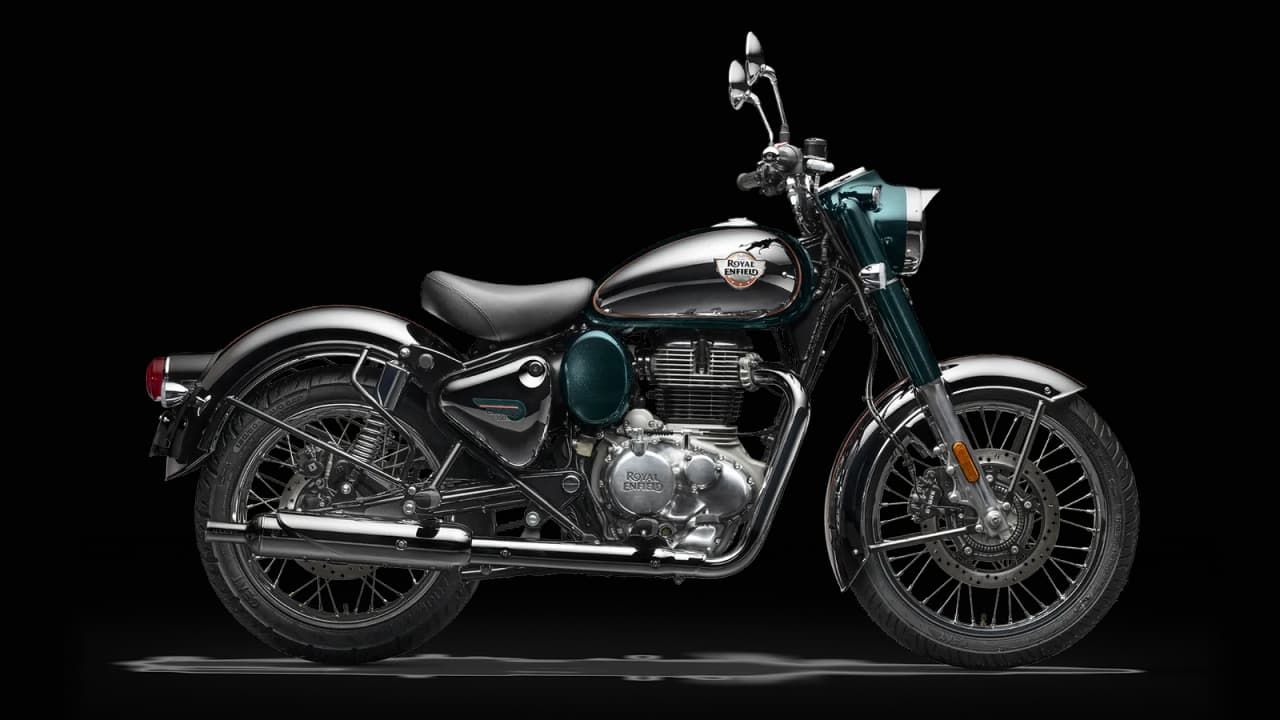
The Classic 350's design is doing exactly what it's meant to: looking like a motorcycle from another era while quietly being a modern machine underneath. The round headlight, the teardrop fuel tank, the traditional casqued instrument layout, and the wide, flat mudguards are all present and correct, and they photograph just as well parked outside a Thamel café as they do on a highway pull-out in the hills. The tank badging carries a prominent Royal Enfield logo finished in contrasting metallic trim, a small detail that lifts the perceived quality of the whole panel.
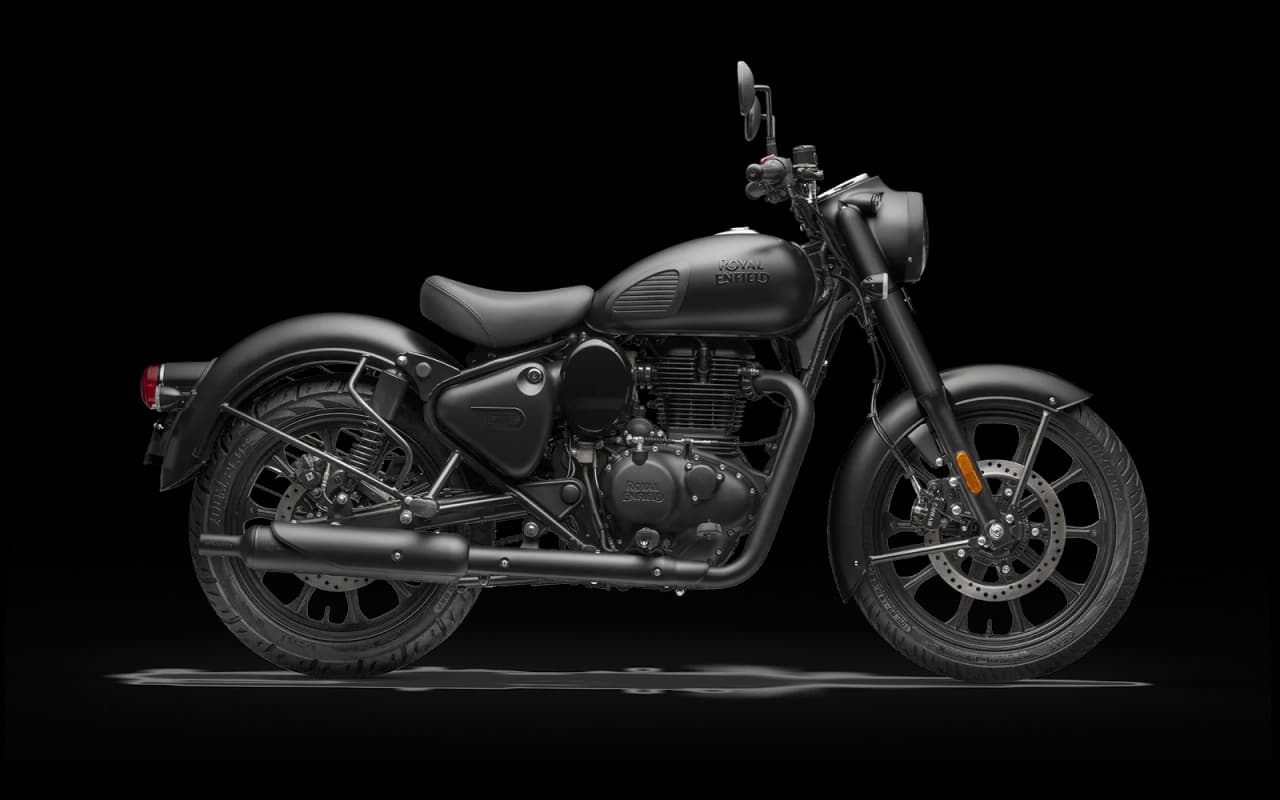
The variant that best demonstrates how far this design language stretches is the Stealth Black. Here the engine cases, exhaust, and most other metal surfaces are treated to a complete matte black finish, which gives the bike a noticeably more brooding, contemporary look than the chrome-heavy Heritage trims. It's a genuinely different personality on the same chassis — one buyer wants the classic gleam of chrome, the next wants the bike to disappear into shadow, and Royal Enfield has built variants to answer both.
Build quality across the range feels consistent with what we've come to expect from Royal Enfield's current generation: the twin downtube spine frame underneath is a properly engineered piece rather than a styling exercise, and panel fit and paint depth are a clear step up from older Classic generations. At 195 kg kerb weight, this is not a light motorcycle, and that mass is part of why it feels so planted and unshakeable at speed — but it's also the same reason it demands respect at walking pace, a trade-off we'll come back to.
Twelve Ways To Buy The Same Motorcycle
Colour and trim choice is genuinely one of the Classic 350's strengths in the Nepali market, and it's worth understanding the structure before walking into a showroom. At the more affordable end, the Heritage trim in Madras Red or Jodhpur Blue starts the range at Rs 5.55 lakh, with the Heritage Premium in Medallion Bronze at Rs 5.66 lakh. Both wear the more traditional face of the Classic 350, and both come on single-channel ABS in their standalone Madras Red and Jodhpur Blue variants at Rs 5.71.5 lakh, or Commando Sand and Medallion Bronze at Rs 5.81.5 lakh.
Move up and the Signals series (Commando Sand) sits at Rs 5.66 lakh, while the Chrome trim in Emerald Green comes in at Rs 5.79,900 and the Dark series — Gun Grey or Stealth Black — at Rs 5.73 lakh. At the top of the ladder sit the dual-channel ABS variants: Emerald at Rs 5.95 lakh, and Stealth Black and Gun Grey both at Rs 5.89 lakh. These top-spec bikes are the ones that pair the fullest equipment list with the most premium colourways, and the Stealth Black in particular has become the variant everyone in the showroom yard seems to gravitate toward — its matte-on-matte treatment simply looks different from anything else parked alongside it, including the military green and standard black variants that tend to sit in the background of most dealership forecourts.
Equipment That Finally Feels Properly Modern
For a motorcycle built around a decades-old design philosophy, the Classic 350's equipment list has quietly caught up with modern expectations. The round LED headlamp, rated at 13.2V and 15.1/17.1W, throws a genuinely usable beam, and it's paired with LED pilot lamps and LED turn signals — a small but appreciated upgrade over the halogen-and-bulb setups older Classics relied on. A USB charging port and a gear position indicator round out the practical features, both things Nepali riders doing longer highway stints will actually use.
The alloy wheel option — 19-inch front, 18-inch rear, both able to run tubeless tyres — is arguably the single most useful equipment upgrade available on this generation. Spoked wheels look period-correct but mean tube-type tyres and a slower, more inconvenient puncture repair; the blacked-out alloys fitted to variants like the Stealth Black solve that problem outright while doubling as a styling upgrade. For anyone doing regular intercity riding where roadside puncture repair isn't always convenient, this is worth prioritising over the chrome-spoke variants.
The Thump Is Still The Point
The 349cc single-cylinder, air-oil cooled engine produces 20.2bhp at 6,100rpm and 27Nm of torque at 4,000rpm — modest numbers on paper, and they're meant to be. This has never been an engine built for outright pace; it's built for a specific kind of mid-range pull and, more than anything, for the sound it makes doing it. Fuelled by electronic fuel injection and running through a 5-speed constant mesh gearbox with a wet multi-plate clutch, the engine's character is low-revving and torque-led rather than eager to chase redline.
Fire it up and the signature deep, thumping exhaust note is still very much intact — it remains one of the most emotionally satisfying parts of owning this motorcycle, and it's a big part of why buyers choose it over more clinically efficient alternatives. The torque peak arriving at just 4,000rpm means the bike doesn't need to be worked hard to feel responsive around town or hauling through a gear on the open road; it simply rolls on. What it won't do is reward high-rev enthusiasm — this is a motorcycle that prefers a relaxed cruise to being thrashed, and riders coming from more performance-oriented 350s should recalibrate their expectations accordingly.
Stability That Rewards a Confident Rider
The chassis is a twin downtube spine frame, and it's paired with 41mm telescopic front forks offering 130mm of travel and twin-tube emulsion rear shocks with 6-step adjustable preload and 90mm of travel. The rear tyre — a 120/80-18 tubeless unit on alloy-wheeled variants — offers the grip and predictability you'd want from a cruiser aimed at long, steady highway stretches rather than tight canyon carving.
On the move, the Classic 350's substantial weight works in its favour: it holds a line with real stability at cruising speed and shrugs off small surface imperfections without feeling nervous. Where that same weight becomes a genuine consideration is at low speed — three-point turns, reversing out of tight parking, or navigating the kind of congested, stop-start traffic common in central Kathmandu can feel like a workout, particularly for shorter or lighter riders. This is consistently the most common practical complaint about the bike, and it's one we'd flag honestly rather than gloss over: 195kg is a lot of motorcycle to muscle around by hand.
A Seat Built For Distance, Not Sport
Ergonomically, the Classic 350 is built around comfort over long distances rather than outright sportiness, and it succeeds at that brief. The seat height of 805mm strikes a sensible middle ground — tall enough to feel commanding, but low enough that riders of average height in Nepal can get both feet flat on the ground at a standstill with no drama, which matters enormously in stop-start city traffic and at traffic lights on a camber.
The split-seat setup itself is generously padded, and combined with well-spaced handlebars and footpegs positioned in a natural, upright riding stance, it's genuinely comfortable across the kind of two-to-three-hour rides that make up most weekend touring in the hills around the valley. This is not a motorcycle that punishes your wrists or lower back the way a committed sportsbike would; it's built to be lived on, and that shows in how unhurried the whole riding position feels.
Braking Hardware That Finally Matches the Image
Every Classic 350 variant gets a 300mm front disc with a twin-piston floating caliper and a 270mm rear disc with a single-piston floating caliper — solid, adequately sized hardware for a bike of this weight and intended use. Where the variants genuinely diverge is in ABS: the top-spec Emerald, Stealth Black, and Gun Grey trims (Rs 5.89–5.95 lakh) come with dual-channel ABS, while the Commando Sand, Medallion Bronze, Madras Red, and Jodhpur Blue single-ABS variants, along with the Heritage and Chrome lines, run single-channel systems.
For buyers who ride two-up regularly, or who do a meaningful amount of wet-season riding on Nepali roads where sudden braking on the rear wheel can be risky, we'd steer firmly toward the dual-channel variants. The extra outlay over the single-channel equivalents is modest against the total price, and the added confidence under hard, unexpected braking — particularly relevant on hill roads with loose gravel patches or sudden traffic stops — is worth paying for.
Living With The Weight Day To Day
Practicality on the Classic 350 is a mixed picture, and it's worth being upfront about both sides. The 13-litre fuel tank is a reasonable size for a bike of this class, and the riding position and seat comfort make it genuinely usable for both daily commuting and longer weekend rides. The USB port is a small but real convenience for anyone navigating by phone.
The flip side is that 195kg kerb figure again — it affects not just low-speed handling but everyday practicality too, whether that's pushing the bike up a slight incline into a garage, holding it upright on uneven ground, or manoeuvring it out of a packed parking row outside a city mall. This isn't a dealbreaker for most buyers who choose this segment with open eyes, but it's a genuine consideration for first-time riders or those who haven't handled a heavier motorcycle before.
The Royal Enfield Meteor 350 Undercuts It On Comfort
Within Royal Enfield's own stable, the Meteor 350 is the Classic 350's closest sibling and its most direct rival for buyer attention. The Meteor 350 shares the same underlying 349cc engine architecture but is tuned and positioned as a more laid-back, cruiser-first motorcycle with a lower seat height and a more relaxed, feet-forward riding stance. Where the Classic 350 leans into vintage, upright styling with round dials and traditional bodywork, the Meteor 350 goes for a cleaner, more contemporary cruiser silhouette with a semi-digital instrument cluster and standard Tripper navigation pod.
For buyers whose priority is comfort over long, straight highway stretches and a more forgiving, easy-going ride, the Meteor 350 makes a strong case. But it doesn't carry the same period-correct visual identity or the community cachet that the Classic 350 has built up in Nepal over years of being the default retro choice — and that intangible matters more to this segment's buyers than most.
The Honda CB350 Brings A Refinement Argument
The Honda CB350 is the other name buyers cross-shop most often against the Classic 350, and it approaches the same retro-cruiser brief from a different engineering philosophy. Built around Honda's reputation for refinement and lower vibration levels at speed, the CB350 tends to appeal to buyers who want the retro look without some of the mechanical roughness traditionally associated with single-cylinder cruisers in this class.
What the Classic 350 counters with is exactly what's made it Nepal's default pick for years: unmatched dealer network depth through Alpha Automotive, a wider spread of colour and trim choices across its twelve variants, and — for many riders — a more distinctive, characterful engine note that the smoother CB350 doesn't try to replicate. Choosing between them genuinely comes down to whether you value outright refinement or classic mechanical character more.
Who Should Actually Sign The Cheque

The Royal Enfield Classic 350 remains the right choice for a very specific and very large group of Nepali buyers: those who want a proper 350cc cruiser with real road presence, a distinctive exhaust note, and the reassurance of a dealer network and parts ecosystem that stretches across the country. It rewards riders who plan to use it for relaxed commuting and weekend touring rather than aggressive city dodging, and it particularly suits anyone prioritising braking safety, in which case the dual-channel ABS variants — Emerald, Stealth Black, and Gun Grey — are worth the extra spend over the entry Heritage trims.
Where we'd point buyers elsewhere is if low-speed manoeuvring in tight urban parking is a daily concern, or if outright performance and lighter handling matter more than character and looks. For everyone else — and that's most of the market this bike has always spoken to — the Classic 350 continues to justify its place as Nepal's benchmark retro motorcycle, and with the current variant spread giving buyers real choice from Rs 5.55 lakh right up to Rs 5.95 lakh, there's a version of it for nearly every budget within that band.
Frequently asked questions
What is the price range of the Royal Enfield Classic 350 in Nepal?
The Royal Enfield Classic 350 is priced between NPR 5.55 lakh and NPR 5.95 lakh in Nepal, depending on the variant.
Explore full specifications, variants & ownership context
Know the product
Key specifications, features & ownership context
Choose a variant to see its recorded specifications and features. Equipment and prices can change across trims.
Latest catalog and directory records supplement the original analysis. Figures may have changed since publication; individual specification and price-check dates appear below.
Rs 5.99 lakh ex-showroom · source checked 9 Oct 2026
Brakes, tyres & suspension
| Specification / feature | Gorkha Edition |
|---|---|
| ABS | ABSVerified specification · 22 Aug 2026 |
Dimensions & weight
| Specification / feature | Gorkha Edition |
|---|---|
| Ground clearance | 170 mmResearched · confirm · 5 Sept 2026 |
Engine & performance
| Specification / feature | Gorkha Edition |
|---|---|
| Max power | 20.5 PSResearched · confirm · 4 Oct 2026 |
Running & ownership
| Specification / feature | Gorkha Edition |
|---|---|
| Claimed mileage | 35 km/lResearched · confirm · 5 Sept 2026 |
Showroom & service support
Distributor: Alpha Automotive Pvt. Ltd. (Royal Enfield Nepal)
129 listed brand showrooms · 22 listed brand service locations
Listed cities include Baglung, Bardibas, Bhairahawa, Bhaktapur, Bharatpur, Biratnagar and 19 more.
Brand-wide directory coverage. Confirm that your nearest workshop supports this exact model, powertrain and warranty work; ask about parts availability and booking time.
Market buzz & buyer priorities
Compiled discussion, including buyer reactions and ownership reports; this is not a verified owner survey or a reliability score. Research dated 13 Oct 2026.
What people like
- parts availability even in remote areas
- Significantly reduced price due to local assembly in Nepal
Concerns to investigate
- Heavy kerb weight makes it challenging to maneuver in Kathmandu traffic
- Stock mirrors tend to vibrate at higher speeds on highways
- Fuel economy is relatively low for daily commuting
More feedback
- Ground clearance can be an issue on the rougher sections of the Prithvi Highway
- The nearly 200 kg kerb weight makes the Classic 350 less convenient in narrow alleys, heavy traffic and tight parking areas.
What buyers ask for
- Resale value in the second-hand market
Nepal ownership context
- Local assembly by Alpha Automotive has made parts more affordable and widely available
- The bike holds the highest resale value in the 350cc segment in the Nepali market
- The dual-channel ABS variants are highly recommended by local riders for monsoon safety
More feedback
- Local service centers are well-distributed across major cities like Pokhara, Butwal, and Itahari
- Nepali buyers pay close attention to the availability and quality of authorised servicing because service experience is a recurring discussion point among Royal Enfield owners.
- Used Classic 350 demand remains strong in Nepal, with older and newer examples often discussed through Facebook Marketplace and Nepali motorcycle communities; resale value depends heavily on year, condition, mileage and maintenance history.
Use these facts alongside the article’s full analysis. Check the final quotation, warranty terms and exact equipment before booking.
Evidence & next steps
Check the details before you buy
Use this guide to build a shortlist. Ask for a written quotation for your chosen variant, including registration, taxes, insurance and finance charges. Confirm the nearest authorised workshop supports that model.
Price sources and dates
These are the recorded distributor-source checks for the selected overview trims. They are separate from the article update and catalog read dates; they do not mean every trim was rechecked today. Confirm the final price with the distributor.
Overview photos come from the corresponding model records; additional article photos carry their own credits. Running costs depend on usage, energy prices, maintenance, insurance and resale value.