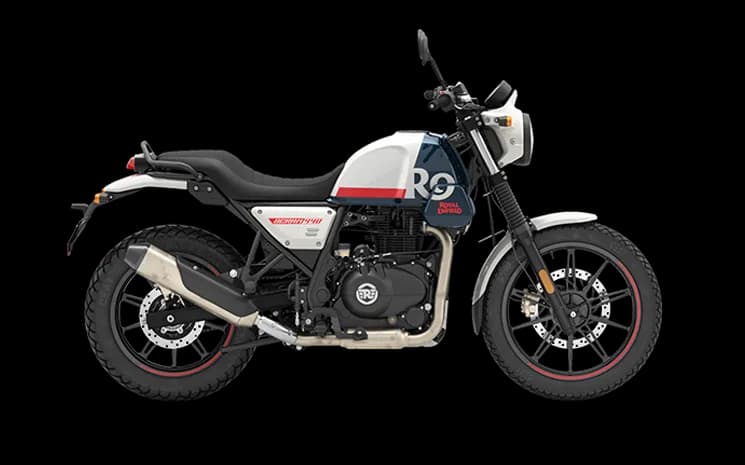
Start with the numbers
The model, at a glance
Top available variants, with prices in Nepalese rupees. Expand details to choose another variant.
| Vehicle | Ex-showroom price | Fuel | Selected variant |
|---|---|---|---|
| 01Royal Enfield Scram 440 | Rs 7 lakh | Petrol | Force |
Ex-showroom prices exclude registration, road tax and insurance. Specifications can vary by trim. See individual source-check dates ↓
Where it sits in the Nepali market
The Scram 440 arrives as Royal Enfield’s middle-ground motorcycle for Nepal. It feels more relaxed and approachable than a full adventure bike, yet it is more serious on rough roads than a street-biased commuter. It is sold here through Alpha Automotive Pvt. Ltd. and backed by 28 showrooms and 22 service centers. That coverage matters in this segment.
At Rs 6,89,900 for the Trail, Rs 6,94,900 for the Scram 440, and Rs 6,99,900 for the Force, it sits in a tight pricing band. The choice is mostly about use case, not budget shock. That is a sensible position in Nepal, where buyers often want one motorcycle to handle city traffic, broken pavement, highway runs, and the occasional dirt detour.
The Scram 440 is also a clear step up from the outgoing Scram 411 formula. The 443 cc engine, 6-speed gearbox, and more mature chassis tuning give it the kind of spread that suits Kathmandu commuting as well as intercity riding. It does not chase headline-grabbing performance. It chases usability.
Looks, design and build
Royal Enfield has kept the Scram 440’s styling deliberately familiar. This is still a scrambler at heart, with simple bodywork, a round LED headlamp, LED tail lamp, upright stance, and the kind of rugged visual mass that buyers in this market tend to trust. It looks purposeful without trying too hard.
The underlying platform is a half-duplex split cradle frame. That is a practical choice for this type of motorcycle. The Trail variant stays closest to the old-school scrambler brief with spoke wheels and tube tyres, while the Force shifts the appeal toward everyday practicality with alloy wheels and tubeless tyres.
Dimensions are compact enough to make it less intimidating than many adventure motorcycles, but the bike still has presence. The Scram 440 measures 2,165 mm long, 840 mm wide and 1,170 mm tall, with a 795 mm seat height and a 196 kg kerb weight. The seat height is friendlier than many taller ADV-style machines. The weight is still substantial when the bike is being manhandled in tight parking spaces or on uneven ground.
The design language is not flashy, and that is part of the appeal. It looks like a machine meant to be used, not parked for attention.
Features and equipment
The Scram 440 is equipped in the way most buyers in this class now expect, but it avoids excess. The instrument cluster is digital-analogue, which suits the bike’s character, and the Tripper navigation pod is included here as part of the package. A Type A USB charger is also present. That remains genuinely useful in daily Nepal use.
Lighting is fully modern where it matters. The headlamp is LED, the tail lamp is LED, and the turn signals use conventional 12V bulbs. That mix is typical of Royal Enfield’s current approach, balancing old-school styling with a few practical upgrades.
The hardware spec is sensible rather than extravagant. Up front, the bike uses a 300 mm hydraulic disc brake with a two-piston floating caliper. At the rear, it gets a 240 mm hydraulic disc with a single-piston floating caliper. Dual-channel ABS is standard, with rear switchability.
The wheel and tyre setup is where the variants separate clearly.
- Trail: spoke wheels and tube-type tyres
- Force: alloy wheels and tubeless tyres
For Nepal, that distinction matters a lot. The Force variant is easier to live with in day-to-day ownership, while the Trail leans toward riders who genuinely want a more off-road-tolerant setup.
Engine and performance
The Scram 440 uses a 443 cc single-cylinder, four-stroke, SOHC, air-cooled, fuel-injected engine. Output is rated at 25.4 bhp and 34 Nm, delivered at 6,250 rpm and 4,000 rpm respectively. A 6-speed gearbox and wet multi-plate clutch complete the package.
On paper, those numbers do not sound dramatic, but they are well chosen for Nepal’s roads. The torque figure is the main story here. The bike should feel strongest in the low and mid range, which is exactly where most riders need help when pulling through traffic, climbing hills, or carrying a pillion.
The 81 x 86 mm bore and stroke point to a long-stroke character. The impression this bike gives is easy, unfussed progress rather than high-rev excitement. Idle speed is listed at 1,300 rpm, and the lubrication system uses a wet sump with semi-synthetic SAE 15W 50 oil specification.
The engine’s temperament is a major part of the Scram 440’s value. It is not trying to be the sharpest or the fastest motorcycle in this price band. It is trying to be flexible, relaxed and capable across bad roads, and that is a much more relevant mission for many Nepali buyers.
Ride, handling and comfort
This is where the Scram 440 makes its strongest case. The bike uses 41 mm telescopic front forks with 190 mm travel and a rear monoshock with linkage offering 180 mm travel. Those numbers are not just brochure filler. They explain the bike’s role very clearly.
The suspension setup is tuned for mixed-use riding, so it should be comfortable over patched city roads, broken back lanes and the kind of imperfect blacktop that defines much of the country’s real-world riding environment. The 200 mm ground clearance is also useful in that context, especially compared with low-slung road motorcycles.
The seat height of 795 mm makes the Scram 440 more approachable than many taller adventure bikes, and that helps in urban use. At the same time, the 196 kg kerb weight means the bike will still feel substantial at low speeds and in parking-lot manoeuvres. That is an important trade-off. The Scram 440 is accessible, but it is not light.
On the road, the bike’s likely strengths are steady composure, relaxed cruising and predictable chassis behaviour rather than quick directional changes. It should suit riders who value stability, comfort and a planted feel more than nimbleness.
Practicality and running costs
Practicality is one of the Scram 440’s strongest arguments. The 15-litre fuel tank is a useful size for long commutes and intercity use, and the claimed mileage of around 30–35 km/l gives it a sensible range for a motorcycle of this displacement.
The Force variant is the easier ownership proposition because tubeless tyres are a major convenience advantage in Nepal. A puncture is simply less disruptive when you do not have to deal with a tube repair every time. The Trail’s tube-type tyres make sense only if the buyer genuinely values the more traditional, off-road-friendly setup.
Cargo capacity is not a major strength. The bike has the usual scrambler limitation of minimal underseat storage, so buyers should not expect scooter-like convenience. That said, the chassis and overall layout should accommodate touring add-ons and luggage solutions better than many roadsters.
Running costs should be reasonable by big-single standards, but this is still a 443 cc motorcycle with a heavy build and premium-brand positioning. The larger service network in Nepal should help with ownership confidence, though buyers should still expect costs that sit above 150 cc and 350 cc motorcycles.
Price, variants and which one to pick
The Scram 440’s Nepal line-up is simple, and that is a strength.
- Trail — Rs 6,89,900
- Scram 440 — Rs 6,94,900
- Force — Rs 6,99,900
The Trail is the most authentic scrambler expression, but its tube tyres make it the least convenient for everyday use. For riders who actually plan to use the bike on rough tracks and do not mind a little ownership hassle, it has the clearest purpose.
The middle Scram 440 variant exists in the pricing structure, but the real purchase decision is usually going to be between Trail and Force. The Force costs only a small premium and brings alloy wheels, tubeless tyres and a more touring-friendly ownership experience. That makes it the variant most buyers in Nepal are likely to prefer.
If the bike were purely about style, the Trail would be enough. If it is about living with the motorcycle every day, the Force is the better buy.
How it compares with its real rivals in Nepal
The Scram 440 does not compete like a typical naked motorcycle; it competes as a do-everything road-and-trail tool. Its nearest real-world rivals in Nepal are other mid-capacity motorcycles that blend comfort, road presence and touring ability, especially models that sit between city commuters and full-size adventure bikes.
Against more traditional Royal Enfield alternatives, the Scram 440 is more versatile than a road-focused classic and less intimidating than a larger adventure model. That middle positioning is its edge. It offers enough torque and suspension travel for difficult roads without demanding the commitment or height of a bigger ADV.
Compared with similarly priced urban-tourers from other brands, the Scram 440’s advantage is character and road presence. Its disadvantage is weight and the lack of outright modern slickness. If a buyer wants the easiest low-speed handling and the cleanest feature spread, there may be more polished options elsewhere. If they want a machine that feels sturdier, more relaxed and better suited to rougher conditions, the Scram 440 makes a strong case.
Verdict and who it suits
The Royal Enfield Scram 440 is one of those motorcycles that makes sense only when viewed through Nepal’s road realities. On paper it is a 443 cc scrambler with modest power, but in practice it is a broad-shouldered, torque-rich, comfortable machine that should fit a lot of real use cases.
It suits riders who want:
- a single motorcycle for city riding and weekend touring
- enough ground clearance and suspension travel for poor roads
- Royal Enfield character without stepping up to a heavier adventure bike
- a machine backed by broad showroom and service coverage
It suits less well:
- riders who prioritise light weight and easy parking-lot handling
- buyers who want maximum feature density for the money
- novices who are uneasy about a 196 kg motorcycle
- anyone who does not want the inconvenience of tube tyres, in the Trail
The clearest recommendation is the Force. It preserves the Scram 440’s core strengths while making ownership easier, and the small premium is justified by the practical gains. The Trail remains the more authentic scrambler, but for most Nepali buyers, the Force is the version that best matches how this motorcycle will actually be used.
Compare Royal Enfield Scram 440 variants side by side
Why tubeless wheels matter more here than the spec sheet suggests
The Scram 440's tubeless alloy wheels read as a minor line item until you have had a puncture outside a town. A tubeless tyre can usually be plugged at the roadside and ridden on, where a tubed tyre on a spoked rim means removing the wheel and finding someone to break the bead. On the kind of mixed highway-and-broken-tarmac riding this motorcycle is bought for, that is a practical advantage rather than a specification.
Where it sits against the other two Royal Enfields
Most Scram 440 buyers are choosing between three bikes in the same showroom. The Himalayan 450 costs meaningfully more and does more with it — more suspension travel, more power, more weight and more bike to manage. The Meteor 350 is the easier, cheaper cruiser answer for someone who is not going to leave the tarmac. The Scram 440 is the middle option: the 443cc platform and a sixth gear, without the Himalayan's price or its bulk.
Explore full specifications, variants & ownership context
Know the product
Key specifications, features & ownership context
Choose a variant to see its recorded specifications and features. Equipment and prices can change across trims.
Latest catalog and directory records supplement the original analysis. Figures may have changed since publication; individual specification and price-check dates appear below.
Rs 7 lakh ex-showroom · source-check date not recorded
Engine & performance
| Specification / feature | Force |
|---|---|
| Engine displacement | 443 ccResearched · confirm · 26 Sept 2026 |
| Max power | 25.8 PSResearched · confirm · 26 Sept 2026 |
Brakes, tyres & suspension
| Specification / feature | Force |
|---|---|
| ABS | Dual-channel ABSResearched · confirm · 26 Sept 2026 |
Dimensions & weight
| Specification / feature | Force |
|---|---|
| Ground clearance | 200 mmResearched · confirm · 20 Sept 2026 |
Showroom & service support
Distributor: Alpha Automotive Pvt. Ltd. (Royal Enfield Nepal)
129 listed brand showrooms · 22 listed brand service locations
Listed cities include Baglung, Bardibas, Bhairahawa, Bhaktapur, Bharatpur, Biratnagar and 19 more.
Brand-wide directory coverage. Confirm that your nearest workshop supports this exact model, powertrain and warranty work; ask about parts availability and booking time.
Market buzz & buyer priorities
Compiled discussion, including buyer reactions and ownership reports; this is not a verified owner survey or a reliability score. Research dated 1 Oct 2026.
What people like
- Improved low-end torque provides better pull for steep uphill climbs in Nepal
- Accessible seat height makes it easier for average-height riders to handle
- High ground clearance is well-suited for navigating potholes and unpaved roads
More feedback
- Distinctive scrambler styling and new color schemes appeal to younger buyers
- Nepali riders describe the Scram 440 as comfortable for relaxed highway riding, hill roads and weekend touring.
- Owners praise its torque, suspension, premium feel and ability to handle broken roads without excessive rider discomfort.
- The simple equipment package and limited electronics appeal to buyers who prefer a straightforward motorcycle.
Concerns to investigate
- same old bike with different launch date
- Lack of a 6th gear limits its performance on highways like the East-West Highway
- Significant weight can be tiring during heavy traffic congestion in Kathmandu
More feedback
- Vibrations are still noticeable when pushing the bike to higher speeds
What buyers ask for
- Ground clearance for diverse road conditions
- Low-end torque for mountain terrain and pillion comfort
- Reliability of the air-oil cooled engine in dusty environments
More feedback
- Availability of spare parts outside the Kathmandu valley
- Annual road tax and total ownership cost
Nepal ownership context
- The 440cc engine falls into a higher tax bracket in Nepal, reflecting its premium positioning over the old 411
- Royal Enfield's extensive service network across Nepal ensures parts are easier to find than other premium brands
- High resale value is expected due to the strong brand loyalty for Royal Enfield in the Nepali market
More feedback
- Fuel efficiency is a concern for daily commuters given the rising petrol prices in Nepal
- Nepali riders commonly compare the Scram 440 with the Himalayan 450, Triumph Scrambler 400 X, KTM 250 Adventure and Royal Enfield Meteor because of its price, weight and touring role.
- The official Nepal specification lists 200 mm ground clearance, 187 kg dry weight, 15-litre fuel capacity and dual-purpose 19/17-inch wheels, which suit Nepal’s mixed city, highway and broken-road use.
- The main Nepal ownership questions concern annual tax, service-centre quality, spare-parts access, fuel cost and resale rather than only engine performance.
Use these facts alongside the article’s full analysis. Check the final quotation, warranty terms and exact equipment before booking.
Evidence & next steps
Check the details before you buy
Use this guide to build a shortlist. Ask for a written quotation for your chosen variant, including registration, taxes, insurance and finance charges. Confirm the nearest authorised workshop supports that model.
Price sources and dates
These are the recorded distributor-source checks for the selected overview trims. They are separate from the article update and catalog read dates; they do not mean every trim was rechecked today. Confirm the final price with the distributor.
Overview photos come from the corresponding model records. Running costs depend on usage, energy prices, maintenance, insurance and resale value.