Start with the numbers
The model, at a glance
Top available variants, with prices in Nepalese rupees. Expand details to choose another variant.
| Vehicle | Ex-showroom price | Fuel | Selected variant |
|---|---|---|---|
| 01BYD Atto 3 | Rs 78 lakh | Electric | Superior |
Ex-showroom prices exclude registration, road tax and insurance. Specifications can vary by trim. See individual source-check dates ↓
Where The Atto 3 Sits In Nepal's Electric SUV Race
Cimex Inc. Pvt. Ltd. brought the BYD Atto 3 into Nepal in 2022, and it remains one of the more expensive mainstream electric SUVs sold here, spread across four variants from Rs 52.99 lakh for the Dynamic to Rs 67.8 lakh for the top Superior trim. That places it firmly in the premium bracket of Nepal's EV market, above budget Chinese crossovers but competing directly with established names like the Hyundai Kona Electric and MG ZS EV. For that money, the Atto 3 isn't trying to be the cheapest electric SUV in the showroom; it's trying to be the most reassuring one to own, built on battery technology BYD has spent over a decade refining, backed by a distributor with genuine after-sales infrastructure in the Kathmandu Valley and beyond.
That positioning matters for Nepali buyers weighing an EV purchase against import duties, loan tenures and resale uncertainty. The Atto 3 isn't a cautious first step into electric motoring; it's a considered upgrade for someone who has done their homework and wants the most complete package rather than the lowest number on the price tag.
A Cabin That Looks Like Nothing Else On The Road
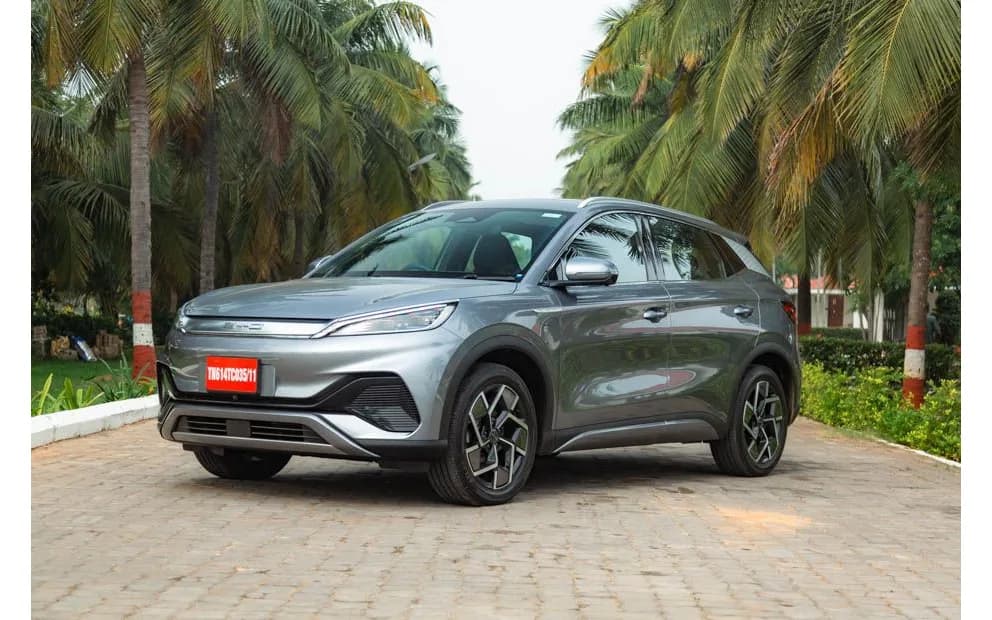
The Atto 3's exterior reads as a clean, modern crossover, but it's the details that make it stand out at a Kathmandu traffic light: bold BYD lettering stamped across both the front grille and rear tailgate leaves no ambiguity about what it is. Standard 18-inch alloy wheels fill the arches well on all four variants, giving the car a planted, substantial stance that doesn't feel undersized next to taller rivals.
Step inside and the quirks continue. BYD has kept the gym-themed interior styling that first drew attention when the Atto 3 launched, a deliberately playful touch in an SUV segment that usually plays it safe. It won't be to every buyer's taste, but it's a refreshing departure from the sea of black-on-black interiors that dominate this price bracket in Nepal, and it gives the Atto 3 real showroom presence.
Iris Blue Leads A Six-Colour Palette
Our showroom review unit came finished in Iris Blue, a deep, slightly muted shade that suits the car's rounded surfacing far better than a flat white would. BYD offers six exterior colours in total for the Atto 3, giving Nepali buyers a genuine choice beyond the usual white-silver-black trio that dominates most competitor ranges. For a car this visually distinctive, we'd encourage buyers to see more than one colour in person before committing, since the metallic blues and greens tend to shift character noticeably between showroom lighting and daylight.
The Screen, The Voice Assistant, And The Kit List That Justifies The Price
The centrepiece of the Atto 3's cabin is its 15.6-inch intelligent rotating touchscreen, a genuinely large display that dwarfs almost everything else in its price class in Nepal. It runs alongside a digital instrument panel and handles Apple CarPlay via USB and Android Auto wirelessly, so phone integration is well covered regardless of which ecosystem a buyer prefers. Sound comes through either a 6-speaker setup or the Dirac HD 8-speaker system depending on variant, both of which are respectable rather than class-leading, but a clear step up from the tinny setups found in cheaper EVs on Nepali roads.
Beyond the screen, the equipment list is where the Atto 3 earns its price tag. A heat pump is standard across the range, a genuinely useful inclusion for winter efficiency in the hills, while automatic air-conditioning comes paired with CN95 and PM2.5 air filtration, a detail that matters more in Kathmandu's dust and pollution than in most other markets BYD sells into. Keyless entry, a portable card key, one-touch windows with anti-pinch on all four doors, and a 6-way power-adjustable driver's seat round out a cabin that feels considerably more premium than its exterior price positioning might suggest. V2L (vehicle-to-load) functionality is also included, letting owners run external appliances or charge equipment directly off the car's battery, a practical touch for load-shedding contingencies that Nepali buyers will appreciate more than most.
A 100kW Motor That's Composed Rather Than Quick
Every Nepal-spec Atto 3 variant we have pricing for shares the same 100kW permanent magnet synchronous motor producing 310 N.m of torque, with a claimed 0-100km/h time of 10.1 seconds. That's a measured, unhurried pace rather than a quick one, and it suits the car's character: this isn't an EV built to win traffic-light drag races, it's one built to move a family SUV smoothly and predictably through city and highway driving alike.
Power delivery is calm and progressive rather than snappy off the line, and there's none of the head-snap immediacy some rival EVs lean on to impress. For Nepali roads, that's arguably the right call. Overtaking on the Prithvi Highway is manageable rather than effortless, and the motor doesn't struggle noticeably even with a full complement of passengers, but buyers coming from a performance mindset should adjust their expectations before test-driving.
Composed Enough In Corners, Distant Through The Wheel
The Atto 3 sits on Macpherson strut front suspension and a multi-link rear setup, a combination that generally favours ride comfort and controlled body movement over outright sharpness. In practice, it manages Kathmandu's patchwork of speed bumps and broken tarmac without feeling harsh, though it doesn't have the last word in composure either; there's a firmness to how it deals with sharper edges that keeps it from feeling truly settled.
Steering is where the car is most compromised. Electric power assisted steering is fitted as standard, but the feel through the wheel is remote, giving little sense of what the front tyres are doing. It's light and easy to place in city traffic, which will suit many buyers just fine, but anyone hoping for genuine driving engagement on the winding roads out of the Valley will find the Atto 3 leaves them wanting.

Front Seats That Impress, Rear Seats That Compromise
Front occupants get a genuinely good deal: 6-way power adjustment for the driver and 4-way for the passenger, synthetic leather upholstery, and a seating position that feels slightly elevated compared to some rivals, giving a commanding view over Kathmandu's traffic. Steering-wheel-mounted controls cover audio, phone and the multi-function display without forcing the driver to hunt for buttons.
The rear tells a more mixed story. Legroom itself is reasonable for the car's 2,720mm wheelbase, and a completely flat rear floor makes fitting three across genuinely easier than in most rivals with a raised centre tunnel. But foot space under the front seats is tight, a specific and repeatedly noted shortcoming that will bother taller rear passengers on longer journeys more than shorter city hops. It's worth having rear passengers sit in the car during a test drive rather than judging legroom from the front seat alone.
Blade Battery Safety Backed By A Full Surround-View Camera
BYD's Blade Battery is the Atto 3's standout safety credential, a lithium iron phosphate design engineered to resist thermal runaway even under puncture, a genuine point of difference in a market where EV fire safety is a real and growing concern among Nepali buyers. Ventilated disc brakes at the front and discs at the rear handle stopping duties, backed by a 360-degree surround-view camera as standard equipment, a feature that earns its keep given the car's substantial 1,875mm width in tight Kathmandu parking.
Everyday Storage That Rewards Careful Packing
Cabin storage is thoughtfully arranged, with a deep centre console compartment and additional space under the armrest supplementing the glovebox. The 60/40 split-folding rear seats add flexibility for longer or bulkier items, and a tyre repair kit is included as standard rather than a full spare, which is worth factoring into any roadside contingency planning on longer trips outside the Valley. Overall, the Atto 3 is a car that rewards buyers who pack with a little forethought rather than one designed purely around cargo volume.
What Ownership Actually Costs Once You're Charging At Home
Running an Atto 3 in Nepal comes down largely to electricity tariffs rather than fuel, and with both Type 2 AC charging and CCS2 DC charging supported at up to 80kW, home charging overnight and occasional fast-charging on longer routes both work well within Nepal's expanding charging infrastructure. Regenerative braking helps recover energy in stop-start Valley traffic, and the heat pump should meaningfully reduce cabin-heating energy draw during Kathmandu's colder months, an efficiency detail that matters more here than in warmer markets. We don't have an officially disclosed range figure for the Nepal-spec car, so buyers should confirm real-world range expectations directly with Cimex Inc. before ordering rather than relying on numbers quoted for other markets.
Picking Between The Four Variants
The range runs from the Dynamic at Rs 52.99 lakh through the Premium at Rs 59,99,000, up to the Advanced at Rs 61,99,000 and the range-topping Superior at Rs 67,80,000, with the Advanced and Superior both confirmed at the same 100kW motor output. For most Nepali buyers, the Premium looks like the sweet spot: it sits meaningfully below the two top trims while still delivering the core Atto 3 experience, the big touchscreen, the digital cluster, the Blade Battery safety story, without stretching into territory where rivals start looking considerably more tempting. Buyers drawn specifically to the higher trims should be clear on exactly what additional equipment the Advanced and Superior badges unlock before paying the premium, and should press Cimex Inc. showrooms for that variant-by-variant breakdown at the point of purchase.
The Hyundai Kona Electric Undercuts It And Still Feels Premium
The Hyundai Kona Electric remains the Atto 3's most direct rival in Nepal's premium EV segment, and it competes on the strength of Hyundai's longer-established service network and a cabin that, while less flamboyant than BYD's, feels equally well finished. Where the Atto 3 wins is sheer screen size and standard equipment count; where the Kona Electric tends to claw back ground is in a slightly more settled ride and the reassurance of a brand with deeper roots in the Nepali market.
The MG ZS EV Offers A More Familiar Price Story
The MG ZS EV is the other name Nepali buyers cross-shop against the Atto 3, typically undercutting BYD's range on price while offering a simpler, more conventional SUV experience. It doesn't match the Atto 3 for cabin theatre or the Blade Battery's safety credentials, but for buyers whose priority is the lowest reasonable entry point into a mainstream electric SUV, the ZS EV remains a legitimate and cheaper alternative worth test-driving back to back.
Our Verdict: Buy It For The Kit, Not The Corners
The BYD Atto 3 is not the electric SUV to choose if driving engagement or class-leading ride comfort top your list; the steering's remoteness and the firmness over rough surfaces will disappoint anyone cross-shopping on those terms. But that has never really been the Atto 3's pitch. It wins buyers over with an enormous, genuinely useful touchscreen, a distinctive and well-equipped cabin, class-relevant safety technology in the Blade Battery, and an equipment list that, variant for variant, is hard to match at this price point in Nepal.
It suits a buyer who wants their EV purchase to feel like a considered, well-supported decision rather than a bargain hunt, someone prioritising standard kit, charging flexibility and battery peace of mind over back-road thrills. Anyone shopping purely on price, or hoping for an engaging drive to match the striking looks, should spend serious time in the Hyundai Kona Electric and MG ZS EV before signing anything at a Cimex Inc. showroom.
Explore full specifications, variants & ownership context
Know the product
Key specifications, features & ownership context
Choose a variant to see its recorded specifications and features. Equipment and prices can change across trims.
Latest catalog and directory records supplement the original analysis. Figures may have changed since publication; individual specification and price-check dates appear below.
Rs 78 lakh ex-showroom · source checked 12 Oct 2026
Battery & charging
| Specification / feature | Superior |
|---|---|
| Battery | 60.48 kWhResearched · confirm · 25 Sept 2026 |
| Claimed range | 420 km (WLTP)Researched · confirm · 25 Sept 2026 |
Safety & driver assistance
| Specification / feature | Superior |
|---|---|
| Airbags | 7 airbagsResearched · confirm · 6 Sept 2026 |
Dimensions & weight
| Specification / feature | Superior |
|---|---|
| Ground clearance | 175 mmResearched · confirm · 25 Sept 2026 |
Claimed range uses the stated test cycle. Different cycles are not a like-for-like range comparison; actual range depends on roads, load, speed and weather.
Showroom & service support
Distributor: Cimex Inc. Pvt. Ltd.
69 listed brand showrooms · 44 listed brand service locations
Listed cities include Anamnagar, Banepa, Bhairahawa, Bhaktapur, Bharatpur, Biratnagar and 11 more.
Brand-wide directory coverage. Confirm that your nearest workshop supports this exact model, powertrain and warranty work; ask about parts availability and booking time.
Market buzz & buyer priorities
Compiled discussion, including buyer reactions and ownership reports; this is not a verified owner survey or a reliability score. Research dated 14 Oct 2026.
What people like
- best bang for the buck EV
- Premium interior quality and unique cabin design
Concerns to investigate
- high price compared to other markets
- Soft suspension causing body roll and underbody scraping on steep ramps
- ADAS features not well-calibrated for local road markings
What buyers ask for
- Real-world range for highway travel (e.g., Kathmandu-Pokhara)
- Ground clearance for local road conditions
- Availability of service centers and spare parts
Nepal ownership context
- The Atto 3 is widely considered a benchmark for EV reliability in Nepal, though newer competitors are challenging its value proposition.
- Service network is extensive compared to many other EV brands, though parts availability outside the Kathmandu valley remains a common point of friction.
- Resale value is relatively stable compared to other EVs, with depreciation tracking around 12-18% annually.
More feedback
- Ground clearance is a frequent concern for owners navigating steep ramps or rough terrain in hilly regions.
- Financing for the vehicle is widely supported by Nepali banks, making it accessible for middle-to-high income earners.
- Its 175 mm ground clearance is adequate for normal Nepali city roads, highways and moderate rough-road use, but it is not intended for serious off-roading.
- Nepal buyers pay close attention to authorised service access, spare-part availability outside Kathmandu and the effect of EV price changes on resale value.
Use these facts alongside the article’s full analysis. Check the final quotation, warranty terms and exact equipment before booking.
Evidence & next steps
Check the details before you buy
Use this guide to build a shortlist. Ask for a written quotation for your chosen variant, including registration, taxes, insurance, finance charges and any charger installation. Confirm the nearest authorised workshop supports that model.
Price sources and dates
These are the recorded distributor-source checks for the selected overview trims. They are separate from the article update and catalog read dates; they do not mean every trim was rechecked today. Confirm the final price with the distributor.
Overview photos come from the corresponding model records; additional article photos carry their own credits. Running costs depend on usage, energy prices, maintenance, insurance and resale value.